A breading supplier’s product may look perfect and perform well in the fryer, but that may not be enough. Food-safety controls, ingredient records, and certification documents must also be in place. HACCP, Kosher, and Halal address different requirements, and they aren’t interchangeable.
All HACCP documentation and Kosher or Halal certificates must be current and apply to the relevant product and manufacturing site. When considering a breading supplier, ask for evidence of its HACCP-based food-safety controls and Kosher or Halal compliance where applicable.
Also ask for the product specification, ingredient declaration, allergen statement, and batch-tracking records for any custom breading formulation. You need to be able to trace every batch of finished blend from its raw ingredients up to where it was shipped.
This article explores what HACCP means in practice, the difference between Kosher and Halal requirements, and what to confirm before deciding on a breading supplier.
What Each System Controls
| System | Main purpose | What to check |
|---|---|---|
| HACCP | Identifies and controls food-safety hazards. | Hazard analysis, critical control points, monitoring records, corrective actions, and verification. |
| Kosher | Confirms that ingredients and production conditions meet Jewish dietary requirements. | Current certificate, exact product and site, Kosher designation, equipment, cleaning, and change-control requirements. |
| Halal | Confirms that ingredients and production conditions meet Islamic dietary requirements. | Current certificate, exact product and site, animal-derived materials, segregation, cleaning, and change-control requirements. |
The systems are not interchangeable. HACCP addresses food safety, while Kosher and Halal address religious dietary requirements and the conditions under which the product is made.
What Does HACCP Cover?
HACCP stands for Hazard Analysis and Critical Control Points. It’s a food-safety system used to identify hazards during food production and control them before they influence the finished product.
Those hazards fall into three main groups:
- Biological hazards, such as harmful microorganisms.
- Chemical hazards, such as cleaning-product residue or undeclared allergens.
- Physical hazards, such as metal, glass, or other foreign objects.
An HACCP plan tracks these hazards through the supplier’s production process. It shows where a problem could occur, how the supplier controls it, and what happens should a control fail.
Critical Control Points
A critical control point, or CCP, is a production step where a food-safety hazard demands control. The HACCP plan names these points and sets out the checks and corrective action required when control is lost.
Breading facilities usually focus their CCPs on critical risk areas such as screening for foreign materials, verifying ingredients, managing allergens, and packaging accuracy. It’s important to note that critical control points aren’t one-size-fits-all; they must be tailored directly to your process, ingredients, and production line.
What Does HACCP Mean for Breading?
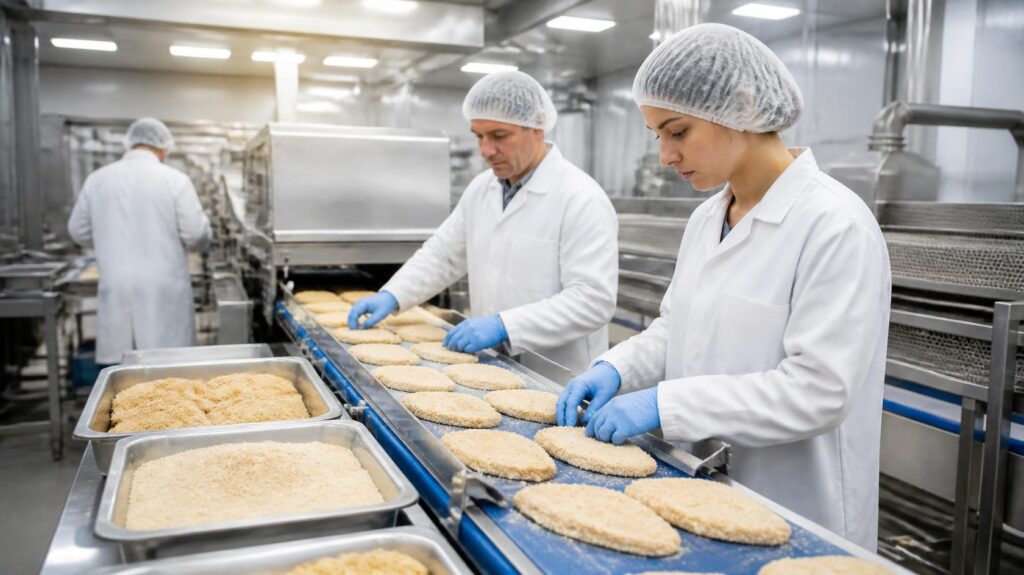
Dry breading has low water content. That limits the growth of many microorganisms, but only to a certain degree. The blend can still become contaminated through packaging, handling, ingredients, equipment, or storage. So, the supplier must control the process from receiving through dispatch.
Critical controls include ingredient specifications, foreign material, allergen cross-contact, moisture, and storage conditions. The supplier should also manage packaging integrity, batch identification, cleaning between production runs, and rework.
Allergen control deserves special attention. Depending on the formula, breading often contains wheat, egg, milk, soy, mustard, sesame, or other common allergens. Get the ingredient list and allergen statement before accepting any blend. If a supplier changes the formula, they must provide their updated paperwork before a single batch goes into production.
What Is Kosher Certification?
Kosher certification means that food products and their manufacturing process meet the stipulations of Jewish dietary law, supervised by a recognized kosher certification body.
Qualifying for Kosher status often depends on much more than the ingredients. It often also indicates approval of additives, processing aids, equipment, the order in which products are made, and the cleaning practices between runs of different products. The certifying body can also review emulsifiers, processing aids, and transportation.
What Should You Request for Kosher Breading?
Ask the supplier for their existing Kosher certificate. Check the basics first. Does it list the precise product name, item code, manufacturing site, certifier, and valid dates? You will also need to confirm whether it’s Dairy or Pareve. Essentially, you need to be sure that the certificate includes the specific blend you buy, not just general products made in the same factory.
Check the rules next. Must the certifier approve recipe changes, new ingredients, or updated cleaning steps? Are there storage or shipping restrictions, and will they alert you if their Kosher status falls away?
The most essential question is not, “Are you Kosher certified?” but, “Does your current certificate include the exact product I’m buying, at this site, under the actual conditions in which it’s made and delivered?”
Why Is Pareve or Dairy Status Important?
A Kosher label on its own doesn’t cover everything a Kosher product requires. You need to know its specific category. Pareve means the product contains no meat or dairy. Dairy Kosher items have particular restrictions, especially where you have to keep specified ingredients separate.
What Is Halal Certification?
Halal certification means that a product fulfills Islamic dietary demands under the standards and oversight of an accepted certification body.
The ingredients, their sources, sanitation, production equipment, processing aids, prevention of contact with non-Halal materials, and storage all affect Halal status. Requirements may be different depending on certifiers and markets.
Some ingredients need to be reviewed more closely than others. For example, flavorings, animal-derived ingredients, fats, emulsifiers, and oils could come under scrutiny. Also, alcohol-related ingredients may require clarification, depending on the certification standard.
What Should You Request for Halal Products?
Ask your supplier for their existing Halal certificate. Check that it’s from a recognized certifier. It should also clearly name your product precisely, the factory where it’s made, its expiration date, and any special rules attached to it.
You also need a full breakdown of what the breading contains. Have the supplier explain all ingredients and processing aids, especially anything derived from animals. Find out how they prevent Halal items from touching non-Halal materials. Confirm their physical separation, cleaning routines, production schedules, storage, and delivery setups.
Additionally, double-check how they handle updates. They must have a set routine to review new ingredients, recipe changes, or status updates before those changes affect your product. Full batch tracking should connect every bag of finished breading blend to its raw ingredients and to the exact customer orders where it was shipped.
Ultimately, a Halal claim needs fresh, product-specific proof. An expired certificate, a blanket company promise, or paperwork for a different product won’t hold up in an audit or inspection.
Why Each Step Matters:
- Certificate details. Proves the paperwork is active and matches your item.
- Ingredients and processing. Spot potential Halal risks early.
- Segregation and cleaning. Prevent cross-contamination.
- Change control and tracking. Ensure safety standards stay consistent over time.
What Should You Ask About Ingredients?
You need full ingredient transparency, especially when your breading is expected to meet strict allergen, Kosher, Halal, or food safety standards.
- Ingredient Sources. Inquire where primary ingredients come from, paying close attention to any animal-derived materials.
- Additives & Aids. Find out if the recipe uses added flavors, colors, emulsifiers, enzymes, or processing aids.
- Allergen Controls. Confirm whether wheat, milk, egg, soy, sesame, mustard, or other allergens are present in the formula or used on shared equipment.
- Formula Updates. Ask how the supplier handles ingredient swaps and how quickly they alert you to recipe changes.
A quick note on labeling claims: Terms like “plant-based” or “clean label” do not guarantee Kosher or Halal compliance. They also can’t replace an official ingredient list or a written allergen statement.
What Documents Should You Ask For?
Before approving a breading supplier, ask for a complete documentation package. Make sure every file names the exact product and factory site you plan to use; not just generic plant paperwork.
- Food Safety & Certificates. An HACCP or safety plan summary, third-party audit reports, and active Kosher or Halal certifications.
- Product Details. The full ingredient list, allergen warnings, nutrition facts, country of origin, and shelf-life limits.
- Quality & Test Records: Chemical and bacterial limits, plus a Certificate of Analysis (CoA) for finished batches.
- Traceability & Recall Plans. Storage rules, lot-coding details, a batch-tracking setup, and written steps for handling product recalls or recipe changes.
How Do Shared Facilities Affect Certification?
Many factories make different products on the same production lines. These facilities can handle a wide mix of ingredients, allergens, and dietary standards. It isn’t necessarily a red flag, but it does mean you need to inspect the supplier’s daily controls carefully.
Key Questions for Shared Facilities
Ask how the plant manages these specific steps to prevent cross-contamination:
- Production Scheduling. Are certified or allergen-free batches run first after a deep clean?
- Line Clearance & Cleaning. How do workers clear, wash, and inspect equipment between production runs of different products?
- Storage & Segregation. Are certified, non-certified, and allergen-containing ingredients kept strictly separate in the warehouse?
- Allergen & Label Control. How do they ensure the right product goes into the right bag with the correct allergen warnings?
- Rework & Waste. How are leftovers, broken batches, or waste materials handled so they don’t accidentally mix into the wrong blend?
- Batch ID & Verification. How do they mark batch numbers and verify that lines are clean before starting a new run?
Important Distinction: Standard Practices vs. Certified Rules
Always ask the supplier which of these steps are strict rules mandated by their certification body (like a Kosher or Halal authority) versus steps that are simply part of their internal food-safety plan.
Why Do Change Notifications Matter?
A breading’s compliance status can change if the supplier changes an ingredient, flavor, processing aid, manufacturing site, equipment, or production process.
A reliable supplier will notify customers before making changes that could affect:
- Ingredient declarations.
- Allergen status.
- Nutritional information.
- Kosher or Halal certification.
- Product performance.
- Shelf life.
- Storage requirements.
- Regulatory compliance.
Notifications are especially important for franchises and food manufacturers, where one formula change can affect menus, packaging, labels, specifications, and multiple operating locations.
How Does This Affect Your Menu?
Certification and food safety information must align with how you market your products. A restaurant should not make a broad Kosher or Halal claim if only a single ingredient or component of the meal is certified.
Businesses should verify whether:
- The breading itself is certified.
- The chicken or main protein is certified.
- The marinade or sauce is certified.
- Shared fryers compromise the claim.
- Preparation surfaces and utensils are properly segregated.
- Which certification mark and exact wording are permitted by the certifying body.
Menu claims should always be reviewed against applicable certification standards as well as local labeling and advertising regulations.
How Can Idan Foods Support Your Requirements?
A reliable breading supplier does more than mix dry ingredients. They need expertise in formulation, allergen and ingredient control, safety certification, batch traceability, and the real-world operational demands of restaurants, caterers, franchises, and manufacturers.
Idan Foods supports food brands with custom chicken breading, private-label dry blending, product development, and coating solutions. When choosing a supplier, don’t just take their word for it; always request the official documentation that proves they meet your standards.
Whether you need an HACCP-controlled breading, a Kosher-certified formula, a Halal-certified coating, or a custom blend with defined allergen and ingredient requirements, contact Idan Foods to discuss your product specifications and supply needs.